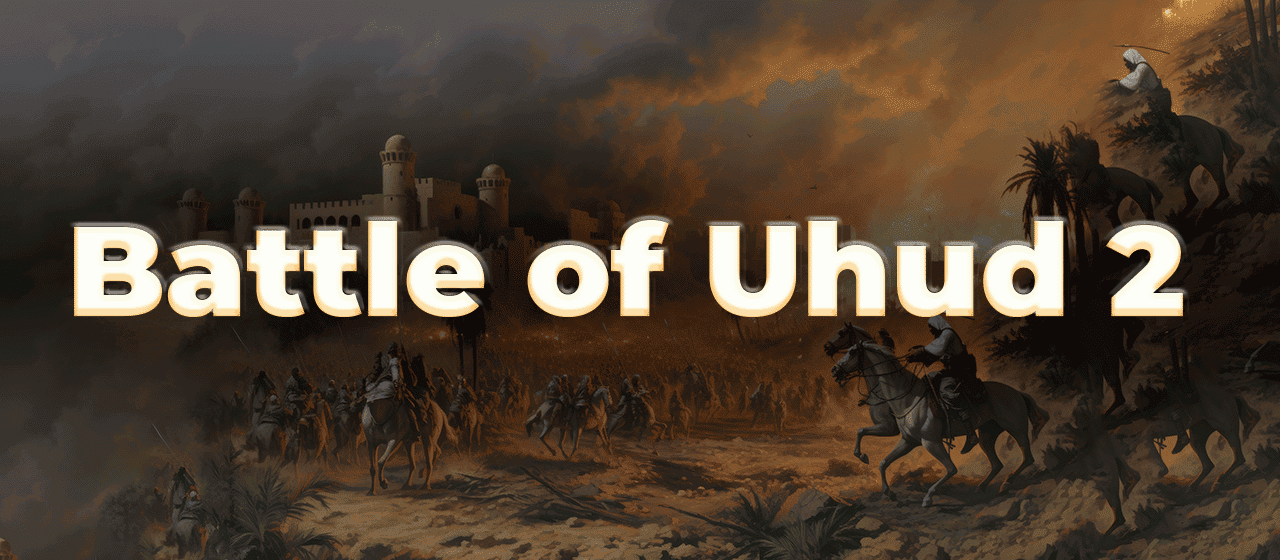
battle of uhud: a test from Allah
Allah Almighty says about the battle of Uhud: “Why [is it that] when a disaster struck you [at Uhud] — although you had struck [the enemy in the battle of Badr] with twice as much — you said, ‘From where is this?’ Say, ‘It is from yourselves.’ Indeed, Allah is over all things competent.” (أَوَلَمَّا أَصَابَتْكُم مُّصِيبَةٌ قَدْ أَصَبْتُم مِّثْلَيْهَا قُلْتُمْ أَنَّى هَذَا قُلْ هُوَ مِنْ عِندِ أَنْفُسِكُمْ إِنَّ اللّهَ عَلَى كُلِّ شَيْءٍ قَدِيرٌ) [Surah Ali ‘Imran: 165]. Defeat began to creep into the ranks of the polytheists, who started contemplating retreat, gradually pulling back. It was a triumph for the Muslim army, no less magnificent than the victory of Badr. Allah Almighty says: “And Allah had certainly fulfilled His promise to you when you were killing them by His permission” [Surah Ali ‘Imran: 152].
Muslims disobeyed the prophet’s commands
As Quraysh retreated and fled early on, the archers assumed the battle of Uhud was over. Spotting the vast spoils left behind, a desire arose within them to claim their share. They called out to one another, “The spoils, O people! The spoils! Your companions have triumphed, so what are you waiting for?” Their commander, Abdullah bin Jubayr, reminded them: “Have you forgotten what the Messenger of Allah (peace be upon him) commanded you?” But they ignored his words, replying: “By Allah, we will join the people and take our share of the spoils.” Thus, they abandoned their positions and headed down into the valley.
khaled ibn al-waleed: The Turning Point of the Battle of Uhud
On the other side, Khalid bin Al-Waleed—who was commanding the right flank of the polytheists—noticed that the Muslims’ rear was now exposed and unguarded by the archers. Seizing the moment, he launched a fierce counterattack from behind. Before the Muslims could even realize what was happening, swords were striking them from every direction, throwing their ranks into utter chaos. He charged with his cavalry toward the few remaining archers. They then swooped down upon the Muslims, who were still preoccupied with gathering the spoils. The attackers shouted to their fleeing comrades, who rushed back to the battlefield. Surrounded on all sides, the Muslims fell into complete disarray. Caught off guard, they dropped the spoils and scrambled for their weapons, fighting blindly to the point where some accidentally killed one another! Worst of all, at that critical moment, they lost contact with the Messenger of Allah (peace be upon him). To make matters worse, a rumor spread that he had been killed, plunging their spirits into utter despair.
Defending Prophet Muhammad
While the Muslims were in the depths of this ordeal, the Prophet (peace be upon him) was facing death himself. The polytheists managed to reach him, hurting his nose and breaking one of his teeth, and wounding his noble face until blood streamed from it. As he wiped the blood away, he said: “How can a people prosper who wound their Prophet?” His face was wounded, his knees were grazed, his lower lip was cut, and his helmet was shattered upon his head, driving two rings of his chainmail visor deep into his cheek. The enemy swarmed around him, intent on killing him, yet he ﷺ stood firm, surrounded by a steadfast handful of believers.
Scenes from the Battle of uhud
Among them was Abu Dujanah, who used his own body as a human shield over the Prophet to protect him from the incoming arrows, which rained down upon his back. There was also Sa’d ibn Abi Waqqas, who shot nearly a thousand arrows that day. Among them, too, was Nusaybah, Umm ‘Umarah Al-Ansariyyah, who abandoned her task of watering the wounded, seized a sword and a bow, and fought fiercely to defend the Messenger of Allah ﷺ until she sustained a deep wound to her neck. Her husband and two sons fought alongside her, prompting the Prophet ﷺ to say to them: “May Allah bless you, O members of this household.” Nusaybah then pleaded: “Supplicate to Allah that we may accompany you in Paradise,” to which he replied: “O Allah, make them my companions in Paradise.” Afterward, she (may Allah be pleased with her) remarked: “I care not what afflictions befall me in this worldly life.” Regarding her, the Prophet ﷺ later said: “Wherever I turned, left or right on the day of Uhud, I saw her fighting in my defense.” That day, she sustained twelve wounds, varying between spear thrusts and sword strikes.
On the authority of Abdullah bin Ka’b bin Malik, it is narrated that Ka’b was the first to recognize the Messenger of Allah ﷺ after the setback, and amid the people’s cries that the Messenger of Allah ﷺ had been killed. Ka’b said: “I recognized his eyes gleaming from beneath the helmet. I shouted at the top of my voice: ‘O Muslims! Rejoice! Here is the Messenger of Allah ﷺ!’ But he signaled to me to remain silent.” When the Muslims recognized the Messenger of Allah ﷺ, they rose and moved with him toward the mountain pass, accompanied by Abu Bakr, Umar, Ali, Talhah, Al-Zubayr, and Al-Harith bin Al-Simmah, among a group of Muslims. As the Messenger of Allah ﷺ ascended into the pass, Ubayy bin Khalaf caught up with him, shouting: “O Muhammad! May I not survive if you survive!” The companions asked: “O Messenger of Allah, should one of us turn and charge at him?” He replied: “Leave him.” When Ubayy drew near, the Messenger of Allah ﷺ took a spear from Al-Harith bin Al-Simmah. Some of the companions later related: “When the Messenger of Allah ﷺ took the spear, he shook it with such a powerful tremor that we scattered away from him just as hair flies off the back of a camel when it shakes itself. He then faced him and thrust the spear into him, causing Ubayy to tumble repeatedly off his horse.” [Hadith Hassan]
The end of the Battle of Uhud
Al-Bara bin Azib (may Allah be pleased with them both) narrated:
The Prophet ﷺ appointed Abdullah bin Jubair as the commander of the infantry (the archers) on the day of the Battle of Uhud, and they were fifty men. He ﷺ said: “Even if you see us being snatched away by birds, do not leave this place of yours until I send for you; and if you see that we have defeated the enemy and trampled them down, do not leave until I send for you.”
Then they (the Muslims) defeated them (the pagans). Al-Bara added: By Allah, I saw the women fleeing so fast that their anklets and legs were visible as they tucked up their clothes.
The companions of Abdullah bin Jubair said: “The spoils of war! O people, the spoils! Your companions have emerged victorious, so what are you waiting for?”
Abdullah bin Jubair said to them: “Have you forgotten what the Messenger of Allah ﷺ told you?”
They replied: “By Allah, we will go to the people (the battlefield) and get our share of the spoils.”
But when they went to them, their faces were turned (by the enemy) and they retreated in defeat. That was the moment when the Messenger was calling them from their rear. (At that point), none remained with the Prophet ﷺ except twelve men. The enemy inflicted seventy casualties upon us. On the day of the Battle of Badr, the Prophet ﷺ and his companions had inflicted one hundred and forty casualties upon the polytheists: seventy captives and seventy killed.
Then Abu Sufyan cried out three times: “Is Muhammad among the people?” The Prophet ﷺ forbade them to answer him.
Abu Sufyan then cried out three times: “Is the son of Abu Quhafa (Abu Bakr) among the people?”
He then cried out three times: “Is the son of Al-Khattab (Umar) among the people?”
He then returned to his companions and said: “As for these, they have surely been killed.”
Umar could not control himself and said: “By Allah, you have lied, O enemy of Allah! Those whom you have counted are all alive, and there remains that which will grieve you.”
Abu Sufyan said: “This day makes up for the day of Badr, and the fortunes of war fluctuate. You will find among your dead some who have been mutilated; I did not order it, nor does it displease me.”
Then he began to chant proudly: “Exalted be Hubal! Exalted be Hubal!”
The Prophet ﷺ said: “Will you not answer him?” They asked: “O Messenger of Allah, what should we say?” He said: “Say: Allah is More Elevated and Majestic.”
Abu Sufyan then said: “We have Al-Uzza, and you have no Uzza.”
The Prophet ﷺ said: “Will you not answer him?” They asked: “O Messenger of Allah, what should we say?” He said: “Say: Allah is our Protector, and you have no protector.” [Sahih Al-Bukhari].
In conclusion, the Battle of Uhud was a turning point in early Islamic history. It served as a profound lesson in discipline and obedience to leadership. Although it ended with painful losses for the Muslims, it ultimately strengthened their resilience and shaped the future strategy of the growing Muslim community.