
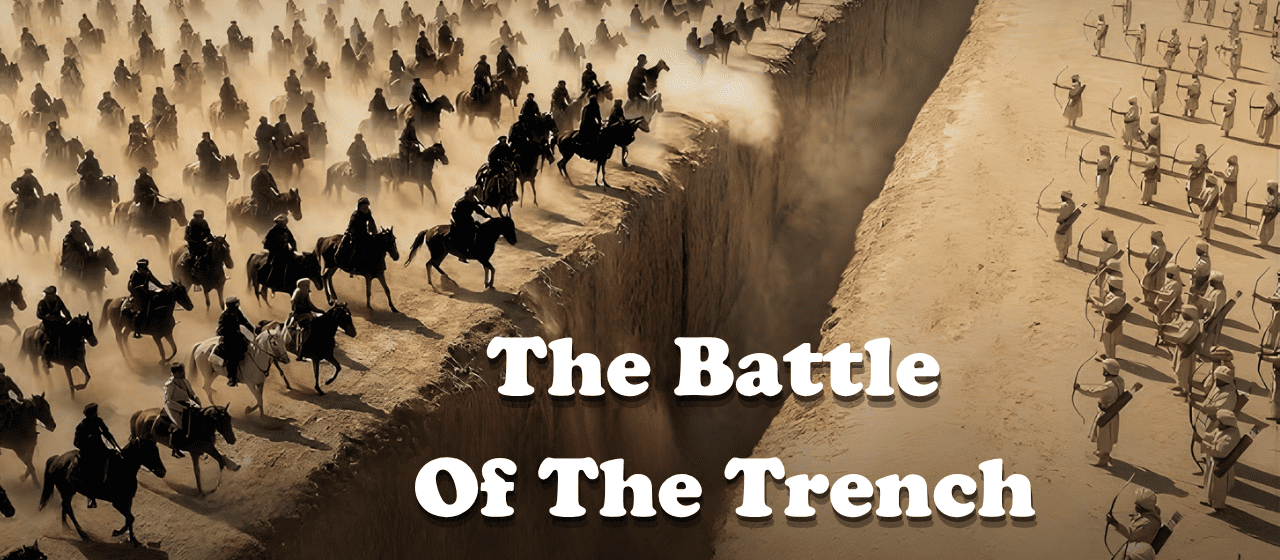
battle of trench: the historical background
The events of the Battle of the Trench took place in Shawwal, 5 AH (March 627 CE). It was one of the major battles in the ongoing conflict between the Muslims and the Quraysh. However, the Quraysh did not fight alone in this campaign. Instead, they formed a powerful alliance with the Jewish tribe of Banu Al-Nadir, who had previously been expelled from Madinah. This coalition united several Arab tribes with the shared goal of eliminating the Muslim community once and for all. Banu Al-Nadir were expelled by Muslims from Madinah in 4 AH after they violated their treaty with the Muslims. Seeking revenge, they played a key role in encouraging the Quraysh and several other Arab tribes to unite against the Muslims, leading to the formation of the confederate army.
the coalition of the disbelievers
The leaders of the Jewish tribe of Banu Al-Nadir, who had taken refuge in Khaybar after their expulsion from Madinah, traveled to Makkah to meet the Quraysh. Among them were Huyayy ibn Akhtab, Sallam ibn Abi Al-Huqayq, Al-Rabi ibn Abi Al-Huqayq, Kinanah ibn Al-Rabi, and others. They urged the Quraysh to wage war against the Messenger of Allah ﷺ and encouraged them to unite with other Arab tribes in a campaign to destroy the Muslim community. They incited the Quraysh to wage war against the Prophet Muhammad ﷺ, promising them their full support and assistance throughout the campaign. Together, they assembled one of the largest armies the Arabs had ever gathered.
Muslims in Madinah
When the Messenger of Allah ﷺ learned about the approaching confederate forces, he gathered his Companions to consult them on the best strategy for defending Madinah. At first, the Companions agreed that they should march out to confront the confederate forces and prevent them from reaching Madinah. Salman Al-Farsi (may Allah be pleased with him) suggested the idea of digging a trench around Madinah as a defensive measure. He said to the Prophet ﷺ:
“O Messenger of Allah, when we were in Persia and feared an attack by cavalry, we would dig a trench around ourselves.”
The Muslims greatly admired Salman’s proposal, and the Prophet Muhammad ﷺ adopted it as the strategy for defending the city. During the digging of the trench, both the Muhajirun and the Ansar proudly claimed Salman as one of their own. The Muhajirun said, “Salman is one of us,” while the Ansar said, “Salman is one of us.” In response, the Prophet Muhammad ﷺ honored him by saying:
“Salman is one of the People of my Household.”
Digging the Trench
The Prophet Muhammad ﷺ ordered the trench to be dug along the northern side of Madinah, as the city’s other sides were naturally protected by closely built houses, dense palm groves, and rocky terrain, making it difficult for the enemy to advance. The work was divided among the Companions, with every group of ten men assigned to dig forty cubits of the trench. Despite the cold weather and the shortage of food, they worked with remarkable determination and enthusiasm. Their spirits were further strengthened by the Prophet ﷺ himself, who joined them in digging the trench and carrying the soil alongside his Companions. The trench dug during the Battle of the Trench measured approximately 5,544 meters (about 5,000 cubits) in length. It was 4 to 4.6 meters wide and about 3.2 meters deep, making it a formidable defensive barrier that prevented enemy cavalry from crossing into Madinah.
Muslims during the battle of the trench
Under the leadership of the Prophet Muhammad ﷺ, the Muslims encouraged one another as they endured the hardship of this exhausting task. They chanted simple poetic chants (rajaz) that eased their fatigue, lifted their spirits, and strengthened their determination as they continued digging the trench. During the digging of the trench, the Muhajirun and the Ansar worked tirelessly, carrying the excavated soil on their backs while chanting:
“We are the ones who pledged allegiance to Muhammad, to remain steadfast upon Islam for as long as we live.”
The Prophet Muhammad ﷺ encouraged them by replying:
“O Allah, there is no true life except the life of the Hereafter, so bless the Ansar and the Muhajirun.”
Despite the severe hunger they endured, their faith and determination never wavered. Their food was extremely scarce, consisting of only a handful of barley prepared with aged fat, yet they continued working with patience and unwavering trust in Allah.
scenes from battle of trench
Allah the Almighty described the severe trials and hardships faced by the Muslims during the Battle of the Trench in the following verses:
”When they came at you from above you and from below you, and when eyes grew wild and hearts reached the throats, and you assumed about Allah various assumptions. There the believers were tested and shaken with a severe shaking.”
(Surah Al-Ahzab 33:10–11){إذْ جَاءُوكُمْ مِنْ فَوْقِكُمْ وَمِنْ أَسْفَلَ مِنْكُمْ وَإِذْ زَاغَتِ الْأَبْصَارُ وَبَلَغَتِ الْقُلُوبُ الْحَنَاجِرَ وَتَظُنُّونَ بِاللَّهِ الظُّنُونَا* هُنَالِكَ ابْتُلِيَ الْمُؤْمِنُونَ وَزُلْزِلُوا زِلْزَالاً شَدِيدا}
These verses vividly portray the intense fear and pressure experienced by the Muslims as enemy forces surrounded Madinah from every direction. The believers faced one of the most difficult tests in their history, yet they remained steadfast in their faith and trust in Allah.
Commenting on these verses, Ibn Kathir explained that Allah was reminding the believers of His favor and mercy when He repelled their enemies and defeated the confederate forces after they had united against the Muslims during the Battle of the Trench in Shawwal, 5 AH. Despite the overwhelming odds, Allah granted victory to the believers and protected Madinah from its attackers.
The Battle of the Trench was one of the greatest battles in Islamic history. Under the leadership of the Prophet Muhammad ﷺ, the Muslims successfully defended Madinah and protected the growing Muslim community. Yet, the story does not end here. In the next article, we will explore the remaining events of the battle in greater detail, along with more of the miracles, lessons, and remarkable incidents that took place during this historic confrontation.