
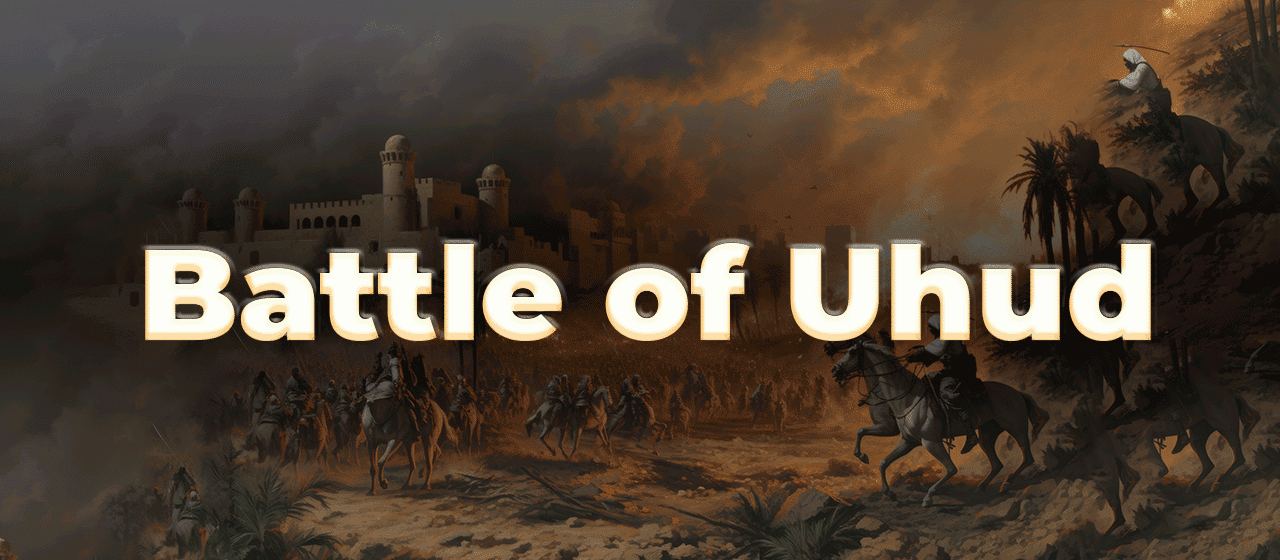
The Battle Of Uhud; the historical background
The tribe of Quraish wanted to take revenge for their defeat in the Battle of Badr, as many of their noblemen were killed during that clash. Beyond that, battle of Uhud established a new equation before the Arabs: Prophet Muhammad (ﷺ) now possessed a formidable army capable of defending the nation of Islam. Therefore, Quraish was determined to regain its honor and prestige among the other tribes across the Arabian Peninsula. They united their resolve to avenge their fallen, eradicate Islam, and dismantle its state.
the army of disbelievers
They marched out with three thousand warriors. Among them were seven hundred armored soldiers and two hundred horsemen led by Khalid bin Al-Waleed and Ikrimah bin Abi Jahl. Accompanying the army were seventeen women, including Hind bint Utbah, the wife of Abu Sufyan, whose father had been killed at Badr. They marched until they reached the heart of the valley facing Uhud—a high mountain located two miles north of Medina—directly opposite the city. This took place on the fifteenth of Shawwal, in the third year of the Hijrah (March 625 CE). It was named after the location of its events near that grand red mountain, which today overlooks the Prophet’s City (Madinah) from the north. However, during the prophetic era, it was situated a few kilometers away from it.
The Muslims’ army
In Madinah, the Prophet Muhammad ﷺ consulted his companions regarding meeting the enemy. The enthusiastic men who had been unable to participate in the Battle of Badr favored marching out to meet the enemy. Their hearts longed for striving in the cause of Allah and they eagerly hoped to attain martyrdom. They repeatedly urged the Prophet Muhammad ﷺ to go out and confront the enemy, saying: “O Messenger of Allah, we have long wished for this day and prayed to Allah for it. Now He has brought it to us and made the journey near. Lead us out to face our enemies so that they will not think we have shrunk from meeting them out of fear.”
Faced with their persistent insistence, the Prophet ﷺ saw no alternative but to adopt this view. He then entered his house and put on his armor in preparation for battle of Uhud. Thus, after leading them in the Friday prayer, the Prophet ﷺ put on his armor and marched out with one thousand warriors.
When the initial excitement of their enthusiasm subsided, they realized that they had pressured the Messenger of Allah ﷺ into a course of action that he had not preferred. Deeply uneasy about what they had done, they began reproaching one another. They then sent Hamzah ibn Abd Al-Muttalib to the Prophet ﷺ to express their regret. Hamzah said:
“O Prophet of Allah, the people have blamed one another and said, ‘Our decision should follow your decision.” However, the Messenger of Allah ﷺ believed that wisdom and resolve required him to proceed with the course he had chosen. He therefore replied:
“It is not fitting for a Prophet, once he has put on his armor, to lay it aside until Allah judges between him and his enemy.”
the night before the battle
On Friday night, the people prepared for departure and made ready for battle of Uhud. The Prophet Muhammad ﷺ appointed those who would remain behind to guard the city, and then the army, consisting of one thousand men, set out, taking a shorter route toward their destination. Then, in an act of treachery, the leader of the hypocrites, Abdullah ibn Ubayy ibn Salul, withdrew from the army midway through the journey, taking three hundred men with him.
The Qur’an recorded these events in the following verses, Surah Al-Imran:
”And what struck you on the day the two armies met was by permission of Allah that He might make evident the [true] believers. (166) And that He might make evident those who are hypocrites. For it was said to them, “Come, fight in the way of Allah or [at least] defend.” They said, “If we had known [there would be] fighting, we would have followed you.” They were nearer to disbelief that day than to faith, saying with their mouths what was not in their hearts. And Allah is most Knowing of what they conceal. (167)”
(وَمَا أَصَابَكُمْ يَوْمَ الْتَقَى الْجَمْعَانِ فَبِإِذْنِ اللَّهِ وَلِيَعْلَمَ الْمُؤْمِنِينَ. وَلِيَعْلَمَ الَّذِينَ نَافَقُوا ۚ وَقِيلَ لَهُمْ تَعَالَوْا قَاتِلُوا فِي سَبِيلِ اللَّهِ أَوِ ادْفَعُوا ۖ قَالُوا لَوْ نَعْلَمُ قِتَالًا لَّاتَّبَعْنَاكُمْ ۗ هُمْ لِلْكُفْرِ يَوْمَئِذٍ أَقْرَبُ مِنْهُمْ لِلْإِيمَانِ ۚ يَقُولُونَ بِأَفْوَاهِهِم مَّا لَيْسَ فِي قُلُوبِهِمْ ۗ وَاللَّهُ أَعْلَمُ بِمَا يَكْتُمُونَ)
at the battlefield
The Prophet ﷺ was left with seven hundred fighters. He positioned the army at the foothills of Mount Uhud on the edge of the valley, placing the mountain behind them as protection. He then instructed his companions:
“Let no one begin fighting until we give the command.”
The Prophet ﷺ organized the army into three battalions: the battalion of the Muhajirun under the command of Mus’ab ibn Umayr, the battalion of the Aws led by Usayd ibn Hudayr, and the battalion of the Khazraj, whose banner was carried by Al-Hubab ibn Al-Mundhir. The Prophet ﷺ also sent the younger boys back and did not permit them to take part in the battle of Uhud.
the bravery of the companions
The Prophet Muhammad ﷺ appointed Abdullah ibn Jubayr as commander of the archers, who numbered fifty men, and ordered them:
“If you see us being carried away by birds, do not leave your position until I send for you. And if you see us defeating the enemy, do not leave your position until I send for you. Protect us with your arrows and do not allow them to approach us from behind. We will continue to prevail so long as you remain steadfast in your place.”
During this battle, the Messenger of Allah ﷺ wore two coats of armor. The battle of Uhud began with a series of individual duels, followed by a full engagement between the two armies. The fighting soon intensified, and the clash grew fierce. On that day, the rallying cry of the Muslims was: “Amit! Amit!”
At the outset of the battle, the Prophet Muhammad ﷺ took up a sword and asked:
“Who will take this sword?”
Many of the Companions stretched out their hands, eager to receive it. He then asked:
“Who will take it with its due right?”
who will take the sword of the prophet muhammad?
At this, the men hesitated. Abu Dujanah (RA) stepped forward and said, “I will take it, O Messenger of Allah, and fulfill its due right.” He then asked, “What is its due right?”
The Prophet ﷺ replied:
“That you do not kill a Muslim with it, nor flee from a disbeliever while carrying it.”
The Prophet Muhammad ﷺ then handed the sword to him. Abu Dujanah tied a red headband around his head and began striding proudly between the ranks, reciting:
I am the one whose beloved companion took my pledge,
Beneath the palm trees on the hillside,
That I would never stand among the rear ranks,
But strike with the sword of Allah and His Messenger.
When the Messenger of Allah ﷺ saw him, he remarked:
“This is a manner of walking that Allah dislikes, except in a situation such as this.”
The biographers relate that Abu Dujanah took the sword and fought fiercely with it, striking down the polytheists until its blade became bent from battle.
The opening stages of the encounter appeared to favor the Muslims, but the events that followed would soon turn the course of the battle into one of the most significant lessons in Islamic history. This will be explored in the next part, in shaa Allah.