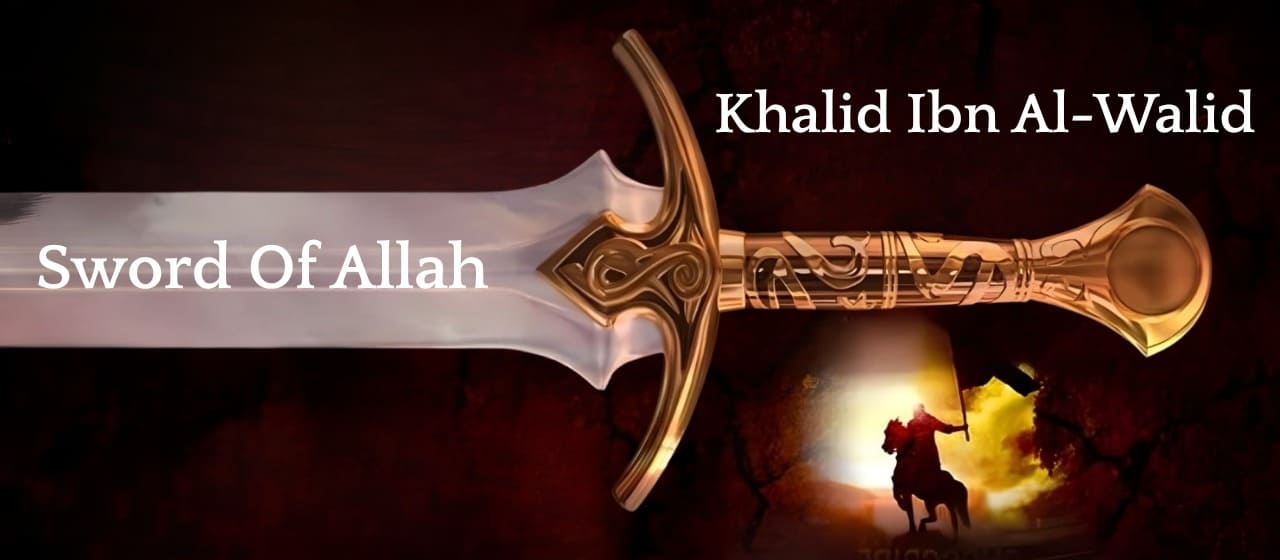
He is widely regarded as one of the most brilliant military strategists in human history. To Muslims, he stands as an iconic figure—the ‘Knight of Islam’—who remained undefeated throughout his entire military career, leading armies that no foe dared to challenge. He fought in more than 100 battles against numerically superior forces of the Romans, the Persians, and their allies. Among his most decisive and renowned victories were the Battles of Al-Yamamah and Al-Yarmouk. He is Khalid ibn Al-Walid, the great companion who was given the title ”The Sword of Allah” by the Prophet Muhammad (ﷺ).
His full name is Abu Sulayman Khalid ibn Al-Walid ibn al-Mughirah, traced his lineage back to Murrah ibn Ka‘b ibn Lu’ayy, the seventh forefather of the Prophet (ﷺ) and of Abu Bakr As-Siddiq (may Allah be pleased with him). Khalid ibn Al-Walid’s family held a distinguished status among the Banu Makhzum. His uncle, Abu Umayyah ibn Al-Mughirah, was known for his wisdom and virtue and was renowned for his generosity and noble character. After his birth, Khalid was sent to one of the desert tribes, where he was entrusted to a wet nurse who raised him. He lived in the desert until the age of five or six. He learned horsemanship and became known for his courage, endurance, boldness, and exceptional skill.
Khalid ibn Al-Walid’s Embrace of Islam
Initially, Sayyiduna Khalid ibn Al-Walid shared the same hostility toward Islam as the rest of the Quraysh. Like many of his kinsmen, he rejected the message of the Prophet Muhammad (ﷺ) and actively sought to fight its spread. He fought in the Battle of Uhud against the Muslim army. His strategic maneuver was one of the key factors in the Muslims’ setback. The Muslims were under the leadership of the Prophet Muhammad (ﷺ), while the polytheists were led by Abu Sufyan ibn Harb. After the archers disobeyed the Prophet Muhammad’s (ﷺ) orders and abandoned their positions atop the mountain to join their companions in collecting the spoils. Khalid ibn Al-Walid noticed the archers descending from the mountain, so he turned against them and attacked the Muslims from the rear, shifting the course of the battle in favor of Quraysh.
KHALID IBN AL-WALID’S EMBRACE OF ISLAM
Khalid ibn Al-Walid (may Allah be pleased with him) embraced Islam later, in Safar of the 8th year of Hijrah, after the Treaty of Hudaybiyyah and before the Conquest of Mecca.
Sayyiduna Khalid said:
“When Allah willed for me what He willed of good, He placed Islam in my heart and guided me to the right path. I said to myself: I have witnessed all these pivotal moments with Muhammad (ﷺ), and in none of them did I see reason to act otherwise, except to withdraw, realizing within myself that I had no rightful place there, and that Muhammad would prevail. When he reconciled with Quraysh at Hudaybiyyah, and Quraysh resisted him with all their might, I asked myself: What remains to be done? Where should I go? To the Negus? He had already embraced Muhammad and his companions, and they were safe under his protection. Or should I go to Heraclius and abandon my faith for Christianity or Judaism? Should I reside under foreign rule, or stay in my homeland among those who remained? At that time, the Messenger of Allah (ﷺ) entered Mecca during the Umrah of Al-Qada, and I was absent, having missed witnessing his entry. My brother, Al-Walid ibn Al-Walid, had entered with the Prophet (ﷺ) during the same Umrah. He sought me but could not find me, so he wrote to me:
“In the name of Allah, the Most Gracious, the Most Merciful. I have never seen anything more astonishing than the departure of your heart from Islam and your mind from reason! Who has ever disregarded Islam in such a way? The Messenger of Allah (ﷺ) asked about you, saying: ”Where is Khalid?’ I replied: ”Allah will bring him.” He said: ”Is this how one disregards Islam? Had he aligned himself solely with the Muslims, it would have been better for him, and we would have advanced him over others.” So seize, my brother, what you have missed of these righteous moments.”
Syyiduna Khaled continued:
”When his letter reached me, it spurred me to set out and strengthened my desire for Islam. I was also heartened by the Prophet’s (ﷺ) inquiry about me. I resolved to go to the Messenger of Allah (ﷺ). I prepared my mounts and set out, until I met Uthman ibn Talhah. We traveled together until we reached Al-Hudda, where we found Amr ibn Al-Aas. He welcomed us, and we returned his greeting. He asked: Where are you headed? We replied: And what brings you out? He said: And what brings you out? We said: To embrace Islam and follow Muhammad (ﷺ). He said: That is what I am following. So he accompanied us until we entered Madinah. We dismounted at the outskirts of Al-Harrah, and the Prophet (ﷺ) was informed of our arrival. He was pleased. I dressed in my best garments and went to meet the Messenger of Allah (ﷺ).
My brother met me and said: Hurry, for the Prophet (ﷺ) has been informed of your arrival and is pleased and awaiting you. We walked quickly, and when I came before him, he was smiling at me. I greeted him with the greeting of Prophethood, and he returned it with a cheerful countenance. I said: I bear witness that there is no god but Allah, and that you are the Messenger of Allah. He said: Come closer.
The Prophet (ﷺ) said: Praise be to Allah who has guided you. I had hoped for you a sound mind and never thought you would embrace anything but the good. I said: O Messenger of Allah, I have seen myself oppose you at many pivotal moments; pray to Allah to forgive me. He replied: Islam erases what came before it. I said: O Messenger of Allah, for that? He prayed: O Allah, forgive Khalid ibn Al-Walid for all that he committed in opposition to Your path. Khalid added: Then Uthman and Amr came forward and pledged allegiance to the Messenger of Allah (ﷺ). Our arrival was in Safar of the eighth year [of Hijrah]. By Allah, the Prophet (ﷺ) never gave preference to anyone among his companions regarding what weighed on my mind and heart.”
Thus concludes the first chapter of his life — a chapter marked by strength, strategy, and relentless opposition. What follows will reveal how that very strength was transformed into one of the greatest forces in defense of Islam.