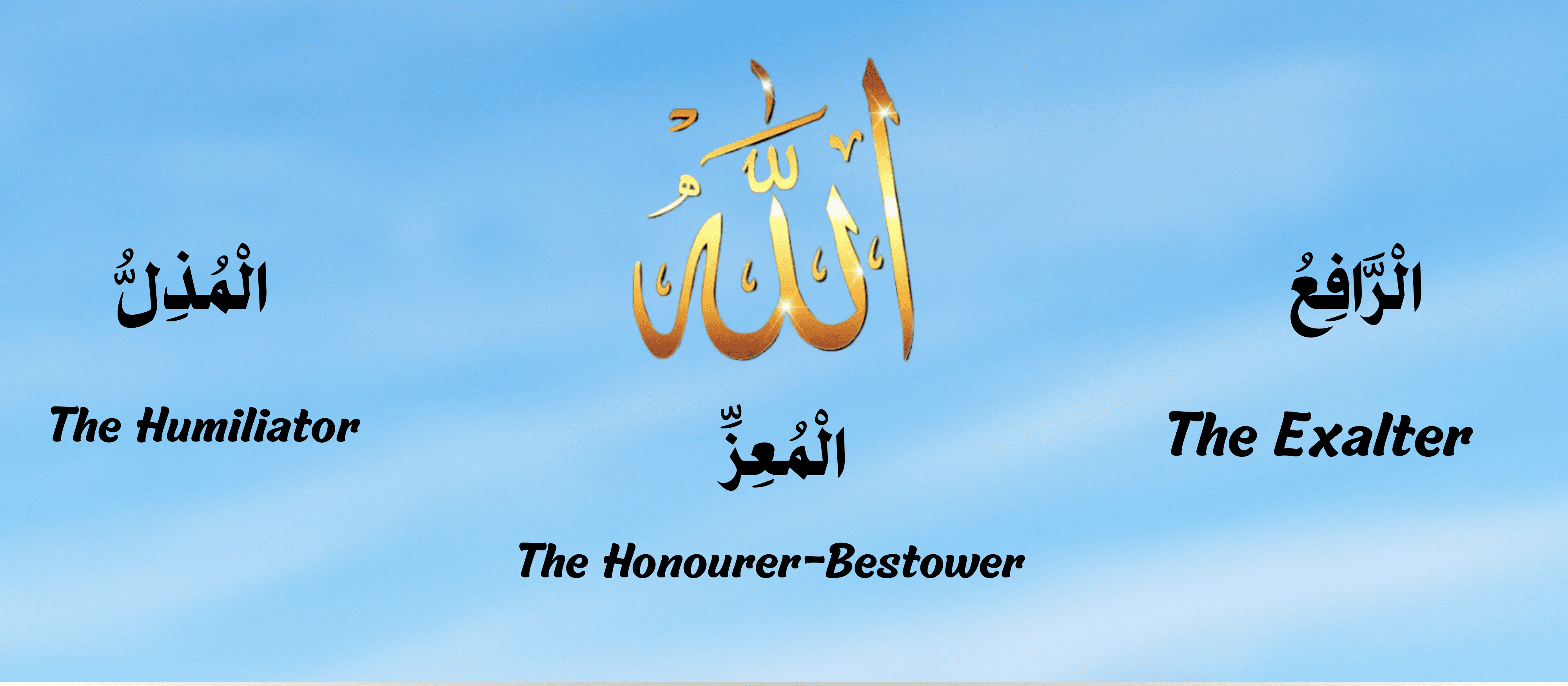
An-Nu’man ibn al-Bashir (RAA) narrated that the Messenger of Allah (ﷺ) said: “Verily, supplication is worship.” The fact that the human being was created in a state of need far Allah makes him seek all the possibilities to connect connect with the Creator. Allah knows the nature of the son of Adam, and He prescribed acts of worship to bring the servant closer to Him. Dua is one of these ways, and how beautiful and readily accepted a supplication is that begins with praising and glorifying Allah with His Names. This article will explore the explanation of the Names of Allah, The Exalter (ٱلْرَّافِعُ), The Honourer-Bestower (الْمُعِزِّ), and The Humiliator (ٱلْمُذِلُّ), and their reflection on the believer’s faith.
ٱلْرَّافِعُ
The Exalter
He is the One who lowers whomever He wills by His decree and raises whomever He wills by His favor. This Name is paired with Al-Khafiḍ, which means ”The Abaser” or “The One Who Lowers. He raises some of His believing servants to the rank He wills, such as the Prophets, and He disgraces whomever He wills as a form of punishment. Allah demonstrates His power by uplifting those who are righteous, knowledgeable, and humble before Him in this life and the Hereafter. Allah said in Surah Al-Mujadilah (58:11); ”Allah will raise those who have believed among you and those who were given knowledge, by degrees.” (يَرْفَعِ اللَّهُ الَّذِينَ آمَنُوا مِنكُمْ وَالَّذِينَ أُوتُوا الْعِلْمَ دَرَجَاتٍ). All ranks, positions, and status are in the Hand of Allah alone. The modern world may suggest that it is governed by material principles; however, the believer knows that it is ultimately ruled by Allah. The heart of the believer is able to withstand the pace of this world through the protection of Allah, knowing deeply that no one can elevate him if Allah wills otherwise. The job or position a person seeks is decreed by Allah. What is with Allah can only be attained through obedience to Him. The teachings of the Prophet Muhammad (ﷺ) also emphasize the significance of Allah’s Name, Al-Rafi (ٱلرَّافِعُ), as he said when he said ”No one humbles himself for the sake of Allah except that Allah raises him.” A person’s position among people is determined by the will of Allah, who controls the hearts and places love or dislike within them. One’s strength stems from the certainty that everything is under the control of Allah, which leads a person to rely solely upon Him, seek His pleasure, and abandon sin and wrongdoing.
الْمُعِزِّ ٱلْمُذِلُّ
The Honourer-Bestower and The Humiliator
He is the Giver of Honor (Al-Muizz) and the Humiliator (Al-Mudhill). Power signifies strength, might, and victory. Power means strength, might, and victory. He decreed power to whomever He wills, and all the world shall follow His orders. All obstacles are removed, paving the way to the honor of His believing servants. Glory can only be obtained from Allah, He says in Surah An-Nisaa:139 ”Those who take disbelievers as allies instead of the believers. Do they seek with them honor [through power]? But indeed, honor belongs to Allah entirely.” (الَّذِينَ يَتَّخِذُونَ الْكَافِرِينَ أَوْلِيَاءَ مِن دُونِ الْمُؤْمِنِينَ ۚ أَيَبْتَغُونَ عِندَهُمُ الْعِزَّةَ فَإِنَّ الْعِزَّةَ لِلَّهِ جَمِيعًا). This meaning has two dimensions: a personal aspect and a global aspect. A person’s honor, respect, and dignity can only be obtained from Allah, even if life appears to be a chain of causes and effects, all of it is ultimately decreed by Allah. He alone controls the beginning and the end. People strive to gain power, yet in the midst of their struggles they forget that this world is created and ruled by Allah. A person’s source of honor among people comes from Allah alone. Allah says in Surah Al-Imran:26 ”Say, “O Allah, Owner of Sovereignty, You give sovereignty to whom You will and You take sovereignty away from whom You will. You honor whom You will and You humble whom You will. In Your hand is [all] good. Indeed, You are over all things competent.”(قُلِ اللَّهُمَّ مَالِكَ الْمُلْكِ تُؤْتِي الْمُلْكَ مَن تَشَاءُ وَتَنزِعُ الْمُلْكَ مِمَّن تَشَاءُ وَتُعِزُّ مَن تَشَاءُ وَتُذِلُّ مَن تَشَاءُ ۖ بِيَدِكَ الْخَيْرُ ۖ إِنَّكَ عَلَىٰ كُلِّ شَيْءٍ قَدِيرٌ). This Ayah explains the global dimension of two of Allah’s Names: Al-Muizz (The Honourer-Bestower) and Al-Mudhill (The Humiliator). Sovereignty and authority are granted and withdrawn by Allah alone.
The opposite of honoring is disgracing. Just as Allah honors, He also humiliates. The Humiliator is the One who humiliates whomever He wills, and no one can honor him. He humiliates whomever He wills, and none can grant honor to the one He has humiliated. The Prophet Muhammad (ﷺ) used to repeat ”O Allah, I seek refuge in You from poverty, lack and abasement, and I seek refuge in You lest I cause or suffer wrong”. The teachings of the Prophet Muhammad encourage believers to seek refuge in Allah from poverty, abasement, and disgrace. Disgrace in this life and in the Hereafter occurs only by the decree of Allah, and believers are required to take the necessary means to protect themselves from it. The ayah in Surah Fatir (35:10) explains how honor and disgrace are determined, ”Whoever desires honor [through power] – then to Allah belongs all honor. To Him ascends good speech, and righteous work raises it. But they who plot evil deeds will have a severe punishment, and the plotting of those – it will perish. (مَن كَانَ يُرِيدُ الْعِزَّةَ فَلِلَّهِ الْعِزَّةُ جَمِيعًا ۚ إِلَيْهِ يَصْعَدُ الْكَلِمُ الطَّيِّبُ وَالْعَمَلُ الصَّالِحُ يَرْفَعُهُ ۚ وَالَّذِينَ يَمْكُرُونَ السَّيِّئَاتِ لَهُمْ عَذَابٌ شَدِيدٌ ۖ وَمَكْرُ أُولَٰئِكَ هُوَ يَبُورُ). May Allah make peace between us and guide us on the path of Islam. Save us from darkness and bring us into the light. Remove acts of deviance from us, both open and hidden. Bless us in our ears, our eyes, our hearts, our wives and our children. TAccept our repentance. Indeed, You are the Ever-Accepting of repentance, the Most Merciful. Make us grateful for Your blessings and among those who praise You for them and proclaim them. Perfect Your favor upon us.