
the prophet Ibrahim leaving his people
The story behind Sa’i between Safa and Marwah begins with the remarkable faith of Hajar, the wife of Prophet Ibrahim, and her desperate search for water for her son Ismail in the barren valley of Makkah. Despite Prophet Ibrahim’s (peace be upon him) relentless efforts to guide his people to the truth, he was met with nothing but stubborn defiance. None among them believed in his message except Prophet Lut, whom Allah later commissioned as a prophet and sent to his own people. Aside from Prophet Lut, no one from Ibrahim’s people accepted his faith.
Upon realizing that preaching to his people yielded no result, Ibrahim declared, ”And Lot believed him. [Abraham] said, “Indeed, I will emigrate to [the service of] my Lord. Indeed, He is the Exalted in Might, the Wise.” (فَآمَنَ لَهُ لُوطٌ ۘ وَقَالَ إِنِّي مُهَاجِرٌ إِلَىٰ رَبِّي ۖ إِنَّهُ هُوَ الْعَزِيزُ الْحَكِيمُ) (Surah Al-Ankabut:26). This meant departing from the land of evil and migrating toward the blessed land. Prophet Ibrahim was blessed with a son. Allah Almighty then commanded him to undertake another profound migration—this time with his wife and his infant son, to settle them in an uncultivated valley, void of any vegetation. Prophet Ibrahim immediately hastened to comply with Allah’s command; he set out with Hajar and Ismail, leaving them in the land of Hijaz, in a barren and uncultivated valley.
Prophet Ibrahim Leaves Hajar and Ismail in Makkah
Ibn Abbas narrated: “The first to use a girdle among women was the mother of Ismail. Then Ibrahim brought her and her nursing son, Ismail, and settled them near the House (of Allah), underneath a large tree above the location of Zamzam, at the highest point of the Mosque. At that time, there was no one in Makkah, nor was there any water. Ibrahim left them there, placing near them a leather bag containing dates and a water skin full of water. As Ibrahim turned to leave, the mother of Ismail followed him and asked, ”O Ibrahim! Where are you going, leaving us in this valley where there is no human soul, nor anything else?” She repeated this several times, but he did not look back at her. Finally, she asked him, ”Did Allah command you to do this?” He replied, ”Yes.” She then said with profound faith, ”Then He will not cause us to be lost.’ She then turned back.” Ibrahim continued walking until he reached the mountain pass (Al-Thaniyah), where they could no longer see him.
Facing the direction of the House, he raised his hands and supplicated with these words ”Our Lord, I have settled some of my descendants in an uncultivated valley near Your sacred House, our Lord, that they may establish prayer. So make hearts among the people incline toward them and provide for them from the fruits that they might be grateful.” (رَّبَّنَا إِنِّي أَسْكَنتُ مِن ذُرِّيَّتِي بِوَادٍ غَيْرِ ذِي زَرْعٍ عِندَ بَيْتِكَ الْمُحَرَّمِ رَبَّنَا لِيُقِيمُوا الصَّلَاةَ فَاجْعَلْ أَفْئِدَةً مِّنَ النَّاسِ تَهْوِي إِلَيْهِمْ وَارْزُقْهُم مِّنَ الثَّمَرَاتِ لَعَلَّهُمْ يَشْكُرُونَ) (Surah Ibrahim:37).
The Trials of Hajar (Sa’i Between Safa and Marwah)
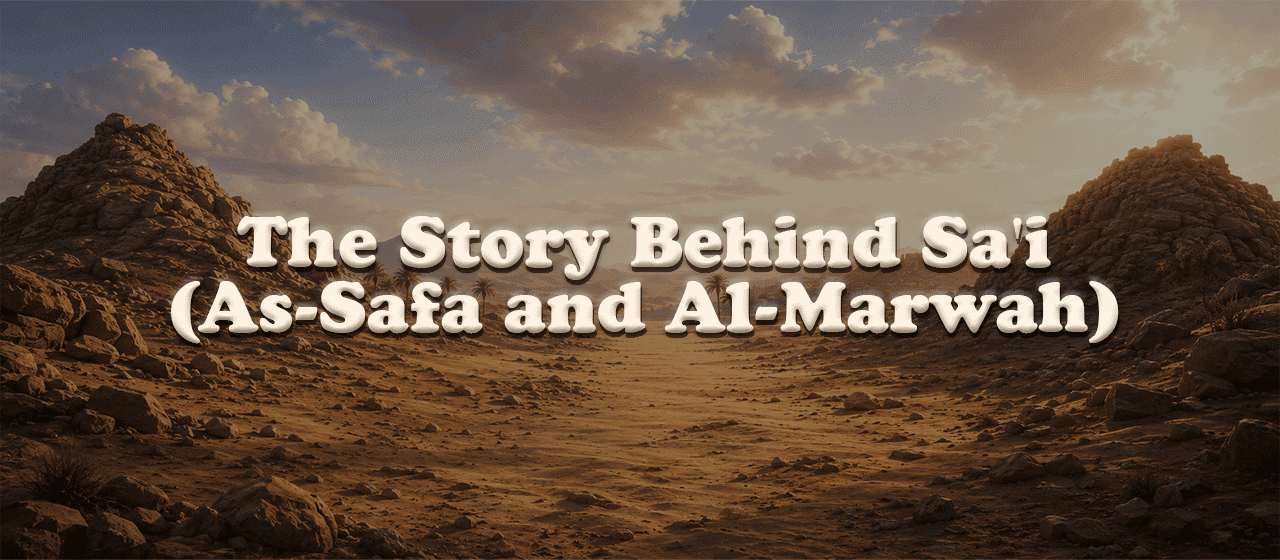
The mother of Ismail continued nursing her child and drinking from her water skin until the water was entirely depleted. She became intensely thirsty, and her infant son grew equally thirsty. As she watched him agonizingly twisting and turning in distress, she could no longer bear to look at his suffering. She left him and found As-Safa to be the closest mountain to her. She stood upon it and faced the valley, searching intently to see if anyone was in sight, but she saw no one. She then descended from As-Safa, and upon reaching the valley floor, she tucked up her garment and ran as fast as a person in utter exhaustion and desperation would run, until she crossed the valley. Next, she climbed Al-Marwah, standing atop it to look for anyone, but again, she saw no one. She repeated this arduous journey seven times. Ibn Abbas narrated that the Prophet Muhammad ﷺ said: “This is the origin of the people’s ritual walking (Sa’i) between them.”
When she reached Al-Marwah for the final time, she heard a sound. She said to herself, “Shsh!” and listened closely. Hearing it once more, she called out, “You have made yourself heard; help us if you have any relief to offer!” Suddenly, she saw an angel at the present site of Zamzam. The angel dug into the earth with his heel (or his wing) until water miraculously gushed forth. She quickly began to form a barrier around the water with her hands to contain it, frantically scooping the water into her water skin, while the spring continued to bubble up vigorously as fast as she scooped.
The Miracle of Zamzam (Sa’i Between Safa and Marwah)
Ibn Abbas narrated that the Prophet Muhammad ﷺ added: “May Allah bestow His mercy upon the mother of Ismail! Had she left Zamzam alone (or had she not scooped its water), Zamzam would have become a flowing stream.” She drank from the water, her thirst was quenched, and she nursed her child. The angel then comforted her, saying: “Do not fear being abandoned or lost, for here lies the House of Allah, which this boy and his father will build. And indeed, Allah never neglects His people.”
The Dawn of Makka: The Arrival of Tribes and Early Settlement
She remained in that state until a caravan from the tribe of Jurhum (or a household from Jurhum) passed by them, approaching from the way of Kadaa. They camped in the lower part of Makkah when they noticed a bird circling in the sky. They said to one another, ”This bird must be circling over water, yet we know this valley has never had any water.” They sent one or two messengers to investigate, and to their amazement, they discovered the spring of water. The messengers returned and informed them, so the people of the caravan advanced toward the water, where the mother of Ismail was resting. They asked, ”Will you permit us to settle here with you?” She replied, ”Yes, but you will have no absolute right to ownership of the water.” They agreed, saying, ”Yes.”
Ibn Abbas narrated that the Prophet Muhammad ﷺ said: “This opportunity came at a time when the mother of Ismail longed for human company.” Thus, they settled there and sent for their families, who came and settled with them, until it became a thriving community of households. Meanwhile, the boy (Prophet Ismail) grew up and learned Arabic from them, becoming deeply admired and cherished by them as he reached youth.
Ultimately, what began as a mother’s desperate search for water in a barren desert became the bedrock of a sacred civilization. Today, during these blessed days of Hajj, millions of Muslims from every corner of the world retrace the exact footsteps of Hajar. As pilgrims perform the ritual of Sa’i between As-Safa and Al-Marwah, they are not merely performing a religious duty; they are reviving the eternal legacy of a mother’s unwavering faith, patience, and absolute trust in Allah. It is a divine tribute to her sacrifice—a timeless reminder that no soul, when relying entirely on Allah, will ever be lost.