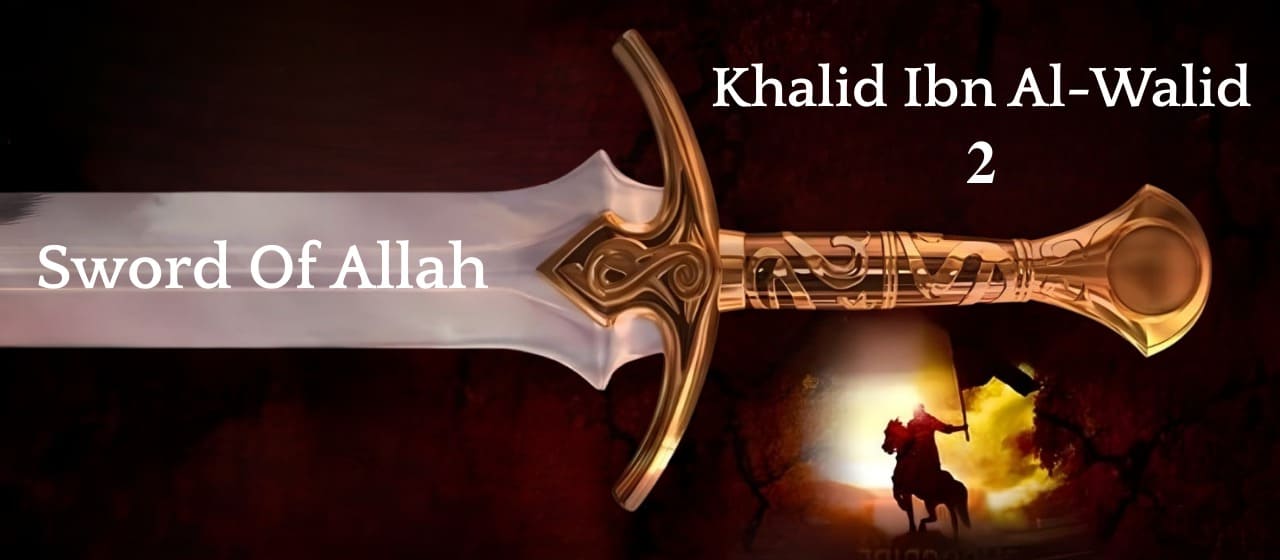
From the very moment Sayyiduna Khalid ibn Al-Walid embraced Islam, a new chapter in Islamic history began. All his extraordinary military skills, strategic brilliance, and strength were now devoted entirely to the service, prosperity, and spread of Islam. The Muslims rejoiced at Khalid ibn Al-Walid’s acceptance of Islam. Allah honored him with Islam, and through him, He granted honor and strength to Islam and the Muslims. The number of battles fought by Sayyiduna Khalid ibn Al-Walid ranged between forty-two, according to the lowest estimates, and ninety-nine, according to some historians. After his conversion to Islam, Sayyiduna Khalid ibn Al-Walid participated in five major battles during the lifetime of the Prophet Muhammad (ﷺ), playing a prominent and decisive role in each of them. The most prominent among them were: The Battle of Mu’tah (where he assumed command and saved the army), the Conquest of Makkah (as the commander of one of the battalions), the Battle of Hunayn, and the expedition of Dumat Al-Jandal.
The Battle of Mu’tah
The first battle Khalid ibn Al-Walid fought after embracing Islam took place four months after his conversion. When the Prophet ﷺ dispatched the expedition of the commanders to Mu’tah to avenge the killing of Al-Harith ibn Umayr, his envoy to the ruler of Busra. At first, Khalid (may Allah be pleased with him) participated as an ordinary soldier, until the three commanders appointed by the Messenger of Allah (ﷺ) were martyred one after another: Zayd ibn Harithah, Jafar ibn Abi Talib, and Abdullah ibn Rawahah. The Muslims were left without a commander, so they chose Khalid as their leader. He managed to deceive the Romans into thinking that reinforcements had arrived for the Muslims by rearranging the army’s formation after each round of fighting. He then executed one of the most remarkable strategic withdrawals in history, successfully saving the Muslim army from total annihilation. Nine swords were broken in his hand during that battle. It was narrated by Sayyiduna Anas that the Prophet (ﷺ) had informed the people about the death of Zayd, Jafar, and Ibn Rawaha before the news of their death reached them. He said with his eyes flowing with tears, “Zayd took the flag and was martyred; then Jafar took the flag and was martyred, and then Ibn Rawaha took the flag and was martyred. Finally, the flag was taken by one of Allah’s Swords (i.e., Khalid bin Al-Walid) and Allah gave them (i.e., the Muslims) victory.”
In conclusion, Khalid ibn Al-Walid’s career following the Battle of Mu’tah marked the beginning of a remarkable military legacy. Transitioning from a tactical savior at Mu’tah to the supreme commander of the Islamic armies, he redefined the art of desert warfare. He remains one of the few military leaders in history to remain undefeated, most notably at the Battle of Yarmouk, which changed the course of world history forever. His brilliance shone through the Ridda Wars, where he unified the Arabian Peninsula, and reached its zenith in the dual conquests of the Persian Sassanid and Byzantine Roman Empires. Khalid ibn Al-Walid passed away in the city of Homs, in Syria, after the Plague of Amwas swept through the lands of Ash-Sham. He (may Allah be pleased with him) said: ”I have participated in nearly a hundred battles. There is not a handspan on my body except that it bears a wound — from a strike, a stab, or an arrow. Yet here I am, dying on my bed as a camel dies. May the eyes of the cowards never find sleep.”
Umar ibn Al-Khattab said upon the death of Khalid: ”Indeed, Islam has suffered a breach that can never be mended.” And he also said: ”By Allah, he was a firm barrier against the enemy, blessed in judgment and resolute in action.” May Allah be pleased with Sayyiduna Khalid, the great warrior, and grant him the highest ranks in Jannah.