
The Situation in Madinah
Before we discuss the Expedition of Banu Qaynuqa, let us first examine the social situation in Madinah. Madinah was not only inhabited by the Muhajirun (the Emigrants from Makkah) and the Ansar (the Helpers of Madinah); there were also the Jews. They were People of the Book and consisted of three groups: the Jews of Banu Qaynuqa, the Jews of Banu al-Nadir, and the Jews of Banu Qurayza. Each group lived in its own fortresses and possessed weapons and fighters. After his Hijrah and settling the affairs between the Ansar and the Muhajirun, the Prophet ﷺ became the one in authority in Madinah, and this came to be known as the Constitution of Madinah (or Sahifat Al-Madinah). This document established constitutional principles to guide the administration of Madinah and regulate relations among its different communities. The terms regarding the Jews were that the Jews would not take any action that could harm the Muslims or form alliances with their enemies, including Quraysh and others. They were also required to help maintain the security and safety of Madinah. If they were not prepared to defend the city, they were still obligated not to betray the Muslims or side with their enemies.
The Jews of Banu Qaynuqa
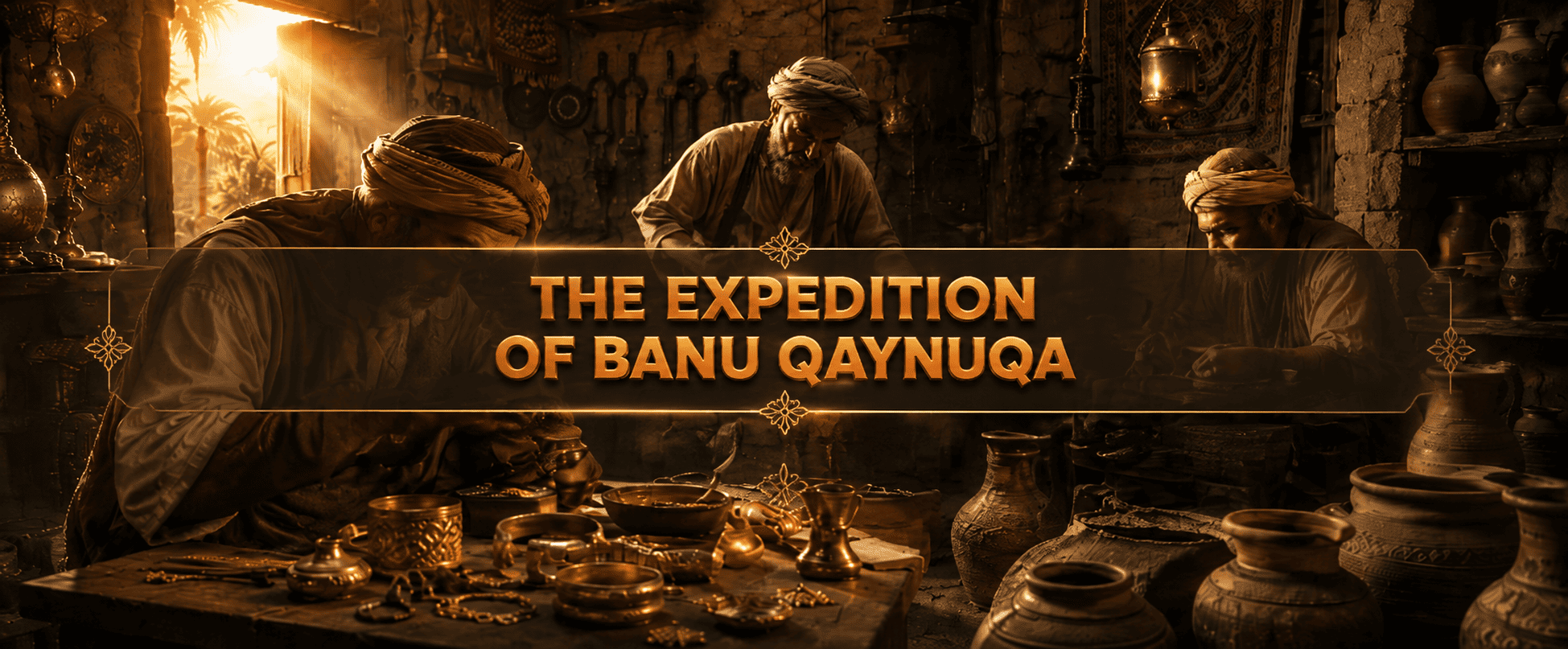
Banu Qaynuqa was one of the three major Jewish tribes that lived in Madinah (Yathrib) in the early Islamic period. They were known for their skills in jewellery-making, blacksmithing, and trade. Their fortresses and shops were concentrated around a market known as the Market of Banu Qaynuqa, located south of the city. They were considered among the strongest and bravest of the Jewish tribes in Madinah. They were also allies of the Khazraj, particularly Ubadah ibn al-Samit and Abdullah ibn Ubayy ibn Salul, before they embraced Islam.
The Jews of Banu Qaynuqa broke their covenant and acted aggressively towards the Muslims. The Prophet Muhammad ﷺ had made a peace agreement with them when he arrived in Madinah as an emigrant. When he learned of their envy after his victory over Quraysh at Badr, he gathered them in their marketplace and said: ”Beware of Allah, lest you suffer the same punishment that befell Quraysh. Embrace Islam, for you know that I am a sent Prophet.” They replied, ”O Muhammad, do not be deceived by the fact that you encountered people who had no knowledge of warfare and gained an opportunity against them.”
The Reason for the Expedition
The first conflict between the Muslims and the Jews took place with Banu Qaynuqa, and it was caused by their breaking of the covenant they had made with the Messenger of Allah ﷺ.
Imam Ibn Hisham mentioned this incident in Al-Sirah al-Nabawiyyah, saying:
”Among the events concerning Banu Qaynuqa was that an Arab woman came to the market with some goods of hers and sold them at the market of Banu Qaynuqa. She then sat with a goldsmith there. They asked her to uncover her face, but she refused. The goldsmith then tied the edge of her garment to her back. When she stood up, her private area was exposed, and they laughed at her. She cried out. A Muslim man then attacked the goldsmith and killed him, and the goldsmith was a Jew. The Jews then attacked the Muslim man and killed him. The Muslim man’s family called upon the Muslims for help against the Jews. The Muslims became angry, and conflict broke out between them and Banu Qaynuqa.”
After the treachery and betrayal of Banu Qaynuqa became clear, the Prophet ﷺ renounced their covenant. The Prophet ﷺ then marched towards them at the head of an army of the Muhajirun and the Ansar and laid siege to them. This took place on a Saturday in the middle of Shawwal in the second year after the Hijrah. Hamzah ibn Abd al-Muttalib carried the Muslim banner on that day, while the Prophet ﷺ appointed Abu Lubabah ibn Abd al-Mundhir al-Ansari as his deputy in Madinah.
The siege lasted for fifteen nights. The Jews found themselves in a difficult situation after the Prophet ﷺ cut off all sources of support reaching them. Eventually, Allah cast fear into their hearts, and they surrendered to the judgment of the Messenger of Allah ﷺ concerning their lives, wealth, women, and children. The Prophet ﷺ then ordered that they be bound.
Abdullah ibn Ubayy ibn Salul and His Role as a Hypocrite
Ibn Ishaq and Ibn Hisham narrated:
”Banu Qaynuqa were the first of the Jews to break the covenant they had made with the Messenger of Allah ﷺ. They fought between Badr and Uhud. The Messenger of Allah ﷺ besieged them until they surrendered to his judgment. When Allah had given him power over them, Abdullah ibn Ubayy ibn Salul came to him and said, ‘O Muhammad, treat my allies well,’ as they were allies of the Khazraj. The Messenger of Allah ﷺ did not respond immediately, so he said, ‘O Muhammad, treat my allies well.’ The Messenger of Allah ﷺ turned away from him, so he put his hand inside the opening of the Messenger of Allah’s armour. The Messenger of Allah ﷺ said to him, ‘Let me go.’ He became angry until they could see the effects of anger on his face, then said, ‘Woe to you! Let me go.’ Abdullah said, ‘No, by Allah, I will not let you go until you treat my allies well. Four hundred unarmoured men and three hundred armoured men have protected me from the red and the black, and you would slaughter them all in a single morning. By Allah, I am a man who fears the consequences of changing circumstances.’ The Messenger of Allah ﷺ then said, ‘They are yours.’”
Allah then revealed:
”You see those in whose hearts is a disease hastening towards them, saying, ‘We fear that a turn of fortune may befall us.’ But perhaps Allah will bring victory or a command from Him, and then they will become regretful for what they concealed within themselves.”
(فَتَرَى الَّذِينَ فِي قُلُوبِهِمْ مَرَضٌ يُسَارِعُونَ فِيهِمْ يَقُولُونَ نَخْشَى أَنْ تُصِيبَنَا دَائِرَةٌ فَعَسَى اللَّهُ أَنْ يَأْتِيَ بِالْفَتْحِ أَوْ أَمْرٍ مِنْ عِنْدِهِ فَيُصْبِحُوا عَلَى مَا أَسَرُّوا فِي أَنْفُسِهِمْ نَادِمِينَ)
(Al-Ma’idah 5:52)
The Judgment of the Prophet ﷺ on Banu Qaynuqa
The Prophet ﷺ ordered them to leave Madinah, and Ubadah ibn al-Samit took charge of their expulsion. The Jews of Banu Qaynuqa left Madinah in humiliation, having laid down their weapons and leaving their property as spoils for the Muslims. The story of Banu Qaynuqa highlights the importance of honouring covenants and maintaining peace and security within the community. Their breach of the covenant eventually led to their siege and expulsion from Madinah. This event also demonstrates how the Prophet ﷺ dealt with challenges facing the Muslim community while upholding the agreements and principles established in Madinah.