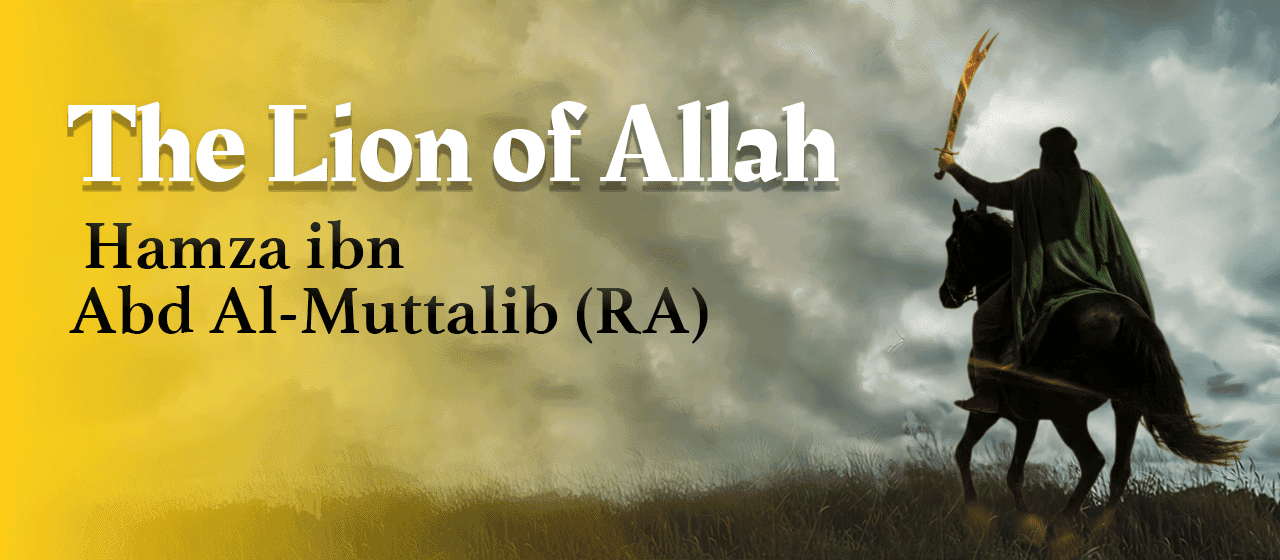
Allah says in the Holy Quran, Surah Al-Ahzab (33:23): ”Among the believers are men who have been true to their covenant with Allah. Some of them have fulfilled their vow (through martyrdom), and some of them are still waiting; and they have not altered in the least.” (مِّنَ الْمُؤْمِنِينَ رِجَالٌ صَدَقُوا مَا عَاهَدُوا اللَّهَ عَلَيْهِ ۖ فَمِنْهُم مَّن قَضَىٰ نَحْبَهُ وَمِنْهُم مَّن يَنتَظِرُ ۖ وَمَا بَدَّلُوا تَبْدِيلًا). By exploring the Seerah of the Companions, we realize how blessed they were to follow the Prophet Muhammad (ﷺ), stand beside him in his struggle, and support him. Similarly, we come to see how blessed we are to have such remarkable role models—to follow their footsteps. Among them is the ”Lion of Allah,” our master Hamza ibn Abd Al-Muttalib (RA). He is the uncle of the Prophet Muhammad (ﷺ) and the Master of Martyrs—he is renowned as the Lion of Allah, known for his courage and strength both in Islam and in the days of ignorance. Hamza ibn Abd Al-Muttalib ibn Hashim ibn Abd Manaf ibn Quṣayy, known by the kunyah Abu Umarah—and it is also said Abu Yala. His mother was Halah bint Uhayb ibn Abd Manaf ibn Zuhrah ibn Kilab ibn Murrah. He was the full brother of Safiyyah bint Abd Al-Muttalib—the aunt of the Prophet (ﷺ) and the mother of Al-Zubayr—sharing both the same parents. He was older than the Messenger of Allah (ﷺ) by two years, and it is also said four, though the first opinion is more correct. He was also the foster-brother of the Prophet.
Hamza’s Acceptance of Islam
There is a difference of opinion regarding the year in which Sayyiduna Hamza (RA) accepted Islam. It is said that he embraced Islam in the second year of Prophethood, while others state it was in the sixth year after the beginning of the Prophetic mission. Abu Jahl once passed by the Messenger of Allah (ﷺ) near Al-Safa, where he harmed, insulted, and spoke ill of him. The Prophet (ﷺ) did not respond and simply walked away. A servant woman of Abdullah ibn Jud’an witnessed what happened. When she later saw Hamza (RA) returning from hunting, carrying his bow, she told him about what his nephew had been subjected to. She said, ”O Abu Umara, if only you had seen what your nephew Muhammad just faced from Abu Al-Hakam ibn Hisham and his companions. He was sitting here when they harmed and insulted him, saying things he disliked. Then they left, and Muhammad (ﷺ) did not respond to them.” Hamza was overcome with anger—by the honor Allah intended for him. He set out immediately, not stopping to speak to anyone, determined that if he met Abu Jahl, he would make him pay for what he had done.
He passed by the leaders of Quraysh without greeting them, then went to the Kaʽbah and circumambulated it. There, he found Abu Jahl among the people and struck him with his bow, splitting his head. He said to him, ”Do you strike him while I follow his religion? Take that back if you can.” Some men of Quraysh stood up to support Abu Jahl and said to Hamza, ”We see nothing but arrogance in you, O Hamza.” He, may Allah be pleased with him, replied, ”What could prevent me, now that the truth is clear to me? I bear witness that he is the Messenger of Allah and that what he says is true. By Allah, I will not withdraw. Stop me if you are truthful.” Abu Jahl then said to the leaders of Quraysh, ”Leave Abu Umara alone, for by Allah, I have insulted his nephew in a despicable way.” With this incident, Sayyiduna Hamza boldly and without hesitation declared, ”I bear witness that there is no god but Allah, and I bear witness that Muhammad is the Messenger of Allah.” The Muslims were greatly honored by Hamza, while Quraysh realized that the Messenger of Allah (ﷺ) had gained honor and stood firm, and that Hamza would protect him.
At first, Sayyiduna Hamza’s (RA) acceptance of Islam was driven by zeal for the Messenger of Allah (ﷺ) and pride that he, as his nephew, would not allow him to be humiliated. Then Allah opened his heart to the truth. Hamza, may Allah be pleased with him, said: ”When anger overcame me and I declared that I was on his path, I felt remorse for leaving the religion of my fathers and my people. I spent the night in doubt over a great matter, unable to sleep. Then I came to the Kaaba and supplicated to Allah, asking Him to open my heart to the truth and remove all doubt from me. Before I could complete my prayer, falsehood was lifted from me, and my heart was filled with certainty. I then went to the Messenger of Allah (ﷺ), and he prayed for me, asking Allah to keep me steadfast.” Before the conversion of Sayyiduna Hamza and Sayyiduna Umar, the Muslims could not pray in public. However, when they both embraced Islam, Allah granted them great support. They marched out with Prophet Muhammad (ﷺ), and the Muslims were arranged in two rows, one led by Hamza and the other by Umar. When Quraysh looked at Umar and Hamza, a sense of despair overcame them like never before.
Sayyiduna Hamza (RA) migrated to Medina shortly before the Prophet (ﷺ), joining the early waves of Muslims fleeing the persecution of the Quraysh. Upon reaching Medina, he stayed in Quba, hosted by Kalthum ibn al-Hadam (or As’ad ibn Zurarah). Following the Hijrah, the Prophet (ﷺ) established a bond of brotherhood between Hamza and Zaid ibn Harithah. With his migration to Medina, a new chapter began in the life of Sayyiduna Hamza—a chapter defined by his unwavering jihad and defense of Islam, the Prophet (ﷺ), and the Muslim community.